
Fitting an appropriately sized First Flush Water Diverter is critical to achieve good quality water.
Water diverters improve water quality, reduce tank maintenance and protect pumps by preventing the first flush of water, which may contain contaminants from the roof, from entering the tank.
When it rains, water slowly builds up in the roof guttering system before it exits through the downpipe. The first flush of water from the roof can contain amounts of bacteria from decomposed insects, skinks, bird and animal droppings and concentrated tannic acid.
It may also contain sediments, water borne heavy metals and chemical residues, all of which are undesirable elements to have in a water storage system.
Instead of flowing to the water tank, these pollutants are diverted with the initial flow of water into the chamber of the water diverter. The water diverters from Rain Harvesting utilise a dependable ball and seat system – a simple automatic system that does not rely on mechanical parts or manual intervention.
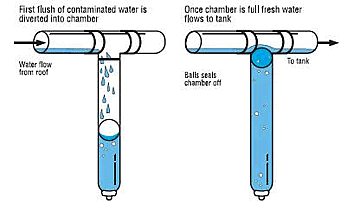
As the water level rises in the flush diverter chamber the ball floats, and once the chamber if full, the ball rests on a seat inside the diverter chamber preventing any further water entering the flush diverter. The subsequent flow of water is then automatically directed along the pipe system to the tank.
For a water diverter to work effectively, the contaminated water in the chamber must be sealed off. This prevents the water passing to the storage tank and ensure the water does not “syphon” off the contaminated water in the chamber. The simplest and surest way to do this is with a floating ball and seat.
A slow release valve ensures the chamber empties itself after rain and resets automatically. The diverted water need not be wasted water because the drain pipe from the flush diverter chamber can be fitted to a standard drip irrigation system.
For more information on the first flush water diverter please contact us either by email or by phone – 1300 885 547
[widget id=”execphp-3″]execphp-3[/widget]
[widget id=”bookmark_me-3″]bookmark_me-3[/widget]
I am having a lot of issues with my rainwater first flush diverters. The bleed washer and filter seem to block up quickly, not allowing the retained first flush to bleed away.
As a result of my investigations, I have several questions on the mechanics of these systems:
1. Is water meant to constantly bleed from the bottom of the first flush container as long as it has water in it?
2. Obviously, in order to fill up the first flush container, the overall flow into the first flush catchment has to be faster than the bleed (?).
3. Rising water in the first flush diverter forces the floating ball up, which (according to the supplied wisdom) then seals the the first flush container, allowing water to flow to the main catchment tanks. When it has stopped raining, the bleeding from the bottom of the diverter ultimately allows the diverter to empty. Why, then, does the system actually require a ball [i.e. when the diverter is full, water has to the divert to the main catchment tanks]? in any case, the first flush container will require incremental top-up to match the bleed from the bottom.
Please correct my understanding as necessary – currently I am thinking the design of these systems is quite flawed.
Thank you.
Mark
Hi Mar
Thank you for your questions regarding First Flush Filters.
To answer your questions:
1. The answer is yes, the bleed hole at the bottom of the container. This idea is that the water bleeds out slowly eventually emptying the first flush pipe so it is ready to take water in the next rainfall.
2. Yes
3. you are correct the ball is to seal against the tee fitting and then divert the rainwater to the mains tanks.
i have 2 diverters on my rainwater tank but they release their contents directly on to the slab holding the tank,flooding the area around the tank.
apart from attaching 2 hoses and diverting the water away ,can i tap into the overflow on the tank itself?
Dear Andy
Thanks for your question, and to answer it yes, you can drill a hole into the overflow pipe and feed a hose from the bottom of the first flush to it.
This would be the best solution to resolve your problem.
I hope this helps you.
Troy